From Writing Rules to Navigating the Fabric
Most people only see their industry change once in a lifetime, but if you’ve been in software for the last twenty years, it feels like we’re on our third.
I’ve had this growing epiphany lately: we aren't just getting better tools. We are living through what Thomas Kuhn called a "paradigm shift." In these moments, the old rules don’t just get faster—they stop being the primary way we solve problems. We move into a new world with a different set of physics.
From Rules to Patterns: How We Got Here
To understand where we are, we have to look at the foundations we've built upon:
-
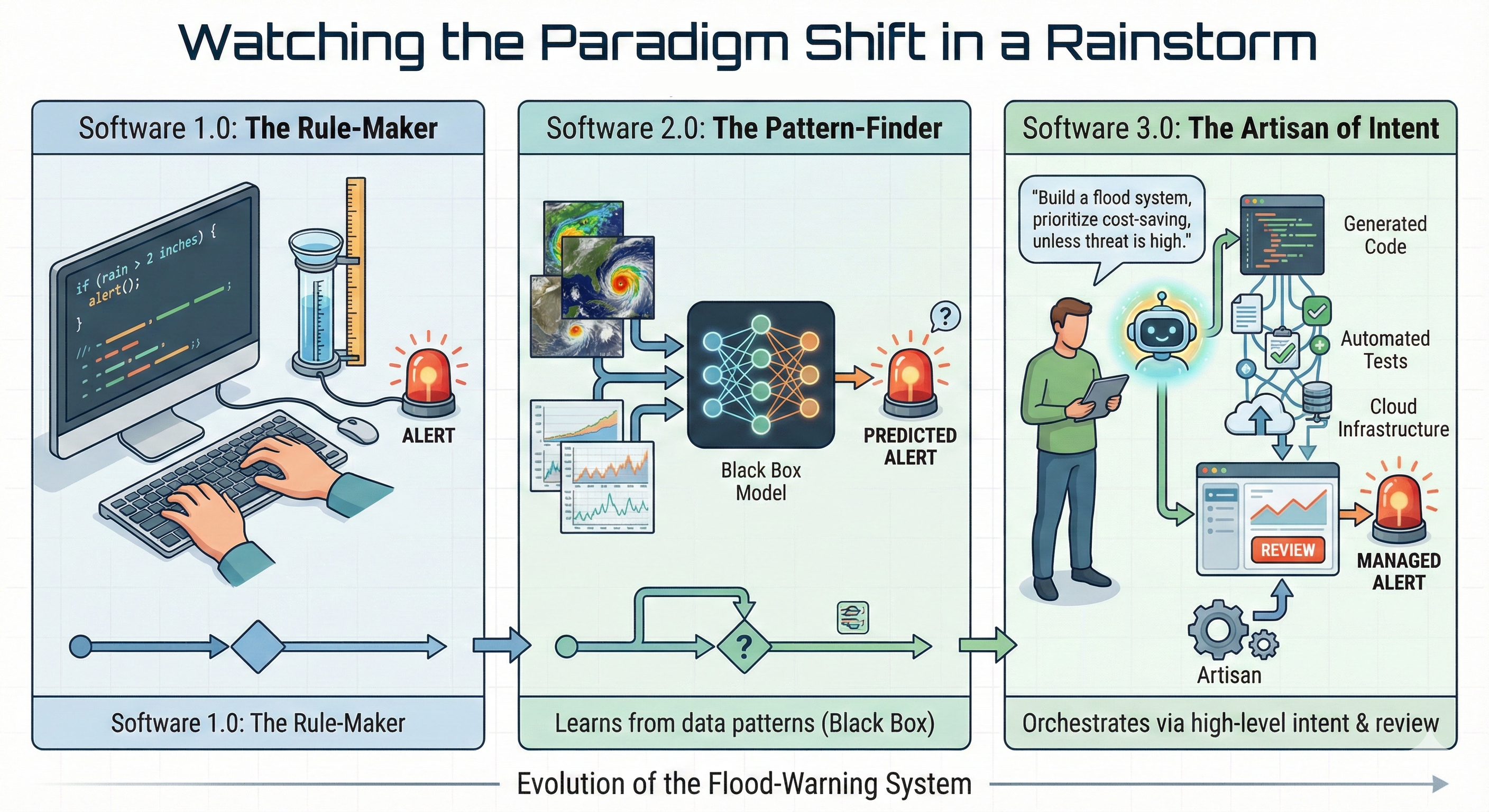
Software 1.0 (The Rule-Maker): This is the world of explicit logic and pure precision. As Rule-Makers, we built systems by hand, ensuring every input had a predictable output. While 3.0 brings incredible speed, the mastery of the Rule-Maker remains our survival kit. You can be the architect of a grand design, but you must still know how the bricks are laid. The "hand-chisel" of 1.0 logic is what allows a developer to recognize when an agent’s discovery has gone off the rails. It is the foundation that keeps the modern fabric from unraveling.
-
Software 2.0 (The Pattern-Finder): Here, we stopped writing rules and started showing computers data. The computer learned the patterns on its own. We moved from defining the "how" to providing the "example."
-
Software 3.0 (The High Artisan): This is the shift happening right now. In this era, the AI handles the code and the tests, while the human developer moves to a higher level of orchestration. Our job is to review the design and manage the intent—acting less like a writer of syntax and more like a senior architect of systems.
Watching the Paradigm Shift in a Rainstorm
Think about how you’d build a system to warn people about dangerous floods. Each era approaches the problem with a different philosophy.
"Software 3.0 isn't about automating away the craft; it's about automating the 'same-ness'—the boilerplate, the repetitive patterns, the predictable syntax—so we can finally focus on the 'difference.' This 'difference' is the high-level architecture, the ethical implications, and the unique business context that a machine, by definition, cannot discover on its own."
Moving from the Grid to the Development Fabric
It is tempting to see the automation of Software 3.0 as a push toward total standardization—a world where every piece of code is a carbon copy. But that is a wrong analysis.
The automation we see today isn't the end goal; it is the substrate. It is more like completing the mesh so the fabric can thrive. By automating the "rules" and "patterns" that consumed our time in previous eras, we are finally free to focus on Discovery.
In this Development Fabric, the lifecycle—designing, coding, and testing—is squeezed into a single dimension. You aren't moving through a sequence; you are navigating a "mesh" of execution where the "process" is automated so that the uniqueness of your intent can take center stage. This is the shift from a world of Standardization to a world of Discovery.
The Initial Connection
Is this truly our "Kuhn Moment"?
It certainly feels like we are standing at the initiation of a new paradigm. We have moved from writing lines to judging intent, and from following a grid to weaving a fabric. But a paradigm shift isn't just a change in tools—it's a change in the "physics" of the work itself.
We are still in the middle of this shift, and the final shape of the stack is still forming. This is only the first connection. Perhaps a deeper look at the "New Physics" of the Fabric is a discovery for another day. For now, the question remains: as the grid disappears, what kind of fabric will you choose to weave?